
In today’s hyper-competitive digital landscape, the gap between companies that ship fast and companies that ship slow isn’t technical talent it’s process. Businesses that invest in structured DevOps services consistently outperform those relying on traditional siloed development and operations models.
Whether you’re a startup trying to move fast or an enterprise trying to modernize, implementing the right DevOps services can be the single biggest lever you pull for growth. In this guide, TechHyves breaks down everything from the fundamentals of DevOps to the cutting-edge trends shaping 2026 and how our team helps businesses like yours navigate it all.
According to the 2025 DORA (DevOps Research and Assessment) report, elite DevOps teams deploy on demand sometimes dozens of times per day while low performers deploy once every few months. The difference is almost entirely architectural and cultural, not technical.
What Is DevOps?
DevOps is the practice of unifying software development (Dev) and IT operations (Ops) into a single, continuous workflow. Instead of developers writing code and throwing it over the wall to ops teams to deploy, DevOps treats delivery as a shared responsibility with automation, feedback loops, and shared tooling at its core.
At its heart, DevOps is about three things: speed (ship faster), stability (break less), and scale (grow without proportional cost increases). With the right DevOps services in place, you can achieve all three simultaneously.
Why DevOps Matters in 2026
Modern software is increasingly complex microservices, multi-cloud environments, containerized workloads, and global user bases mean that manual processes simply can’t keep up. DevOps isn’t optional anymore; it’s the baseline expectation for any serious software organization.
The DevOps Lifecycle
DevOps operates as an infinite loop of continuous improvement across eight core phases:
| Phase | Description |
|---|---|
| Plan | Define requirements, backlog, and sprint goals with stakeholders |
| Develop | Write code collaboratively using version-controllde branching strategies |
| Build | Compile and package code using automated build pipelines |
| Test | Run automated unit, integration, and security tests on every commit |
| Release | Gate and stage approved builds for production deployment |
| Deploy | Push to production via zero-downtime rolling or canary deployments |
| Operate | Manage live infrastructure, scaling, and incident response |
| Monitor | Collect metrics, logs, and traces feed insights back into planning |
Key DevOps Services We Provide
TechHyves offers a full spectrum of DevOps services tailored to your technology stack, team size, and growth stage. Here’s what each service involves and why it matters.
CI/CD Pipeline Setup in Devops Services
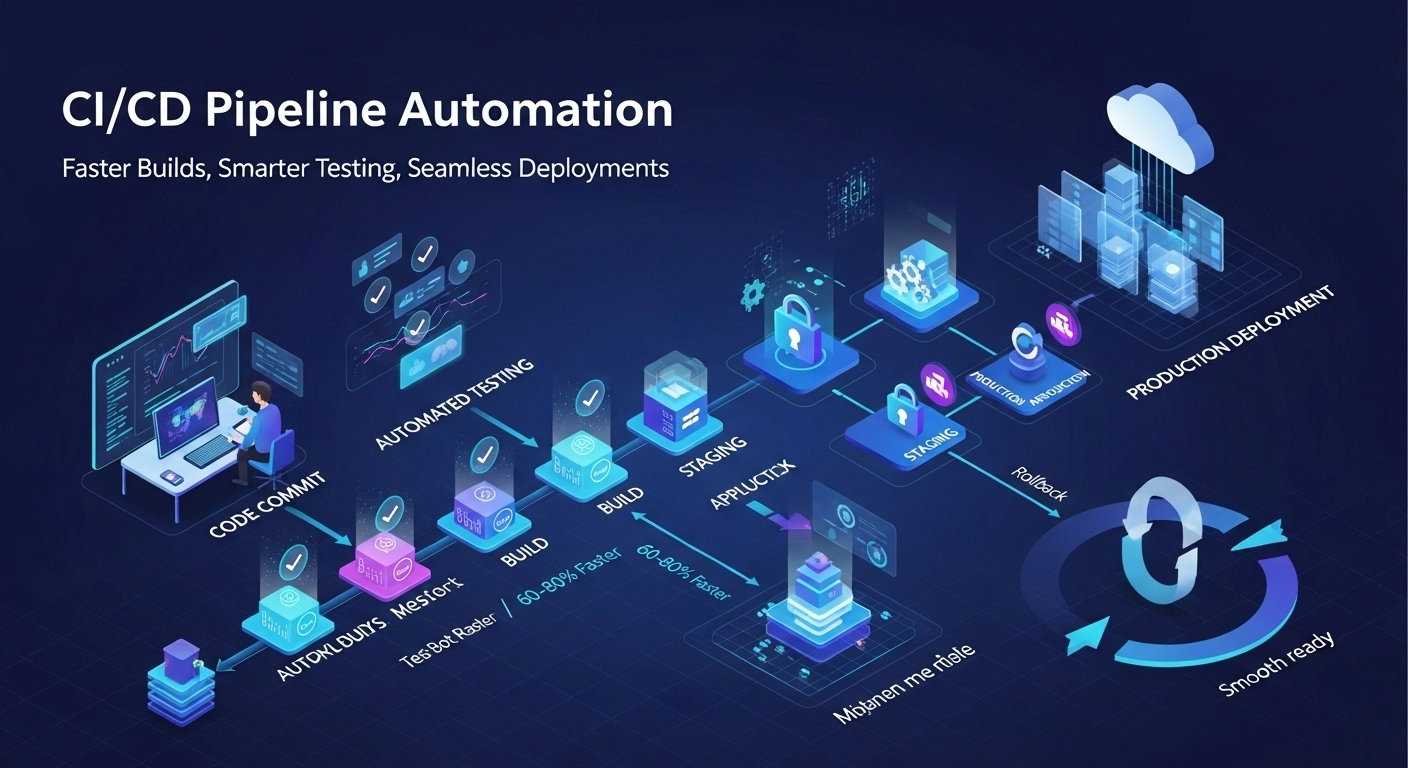
Continuous Integration and Continuous Delivery (CI/CD) is the backbone of any modern software team. We design and implement pipelines that automatically test, build, and deploy code on every commit eliminating manual release processes entirely.
- Automated test suites triggered on every pull request
- Multi-stage pipelines (dev → staging → production) with approval gates
- Parallel build execution to cut pipeline runtime by 60–80%
- Rollback automation for failed deployments
CI/CD Pipeline Setup – Tech Hyves
Cloud Infrastructure Management (AWS · Azure · GCP)
Whether you’re already in the cloud or just starting your migration, our team manages the full lifecycle of your cloud infrastructure across all major cloud providers.
- Multi-cloud architecture design and right-sizing
- Cost optimization most clients save 30–45% on cloud spend within 90 days
- Auto-scaling policies tied to real application load
- Disaster recovery and high-availability architecture
Containerization (Docker · Kubernetes)
We containerize your applications using Docker, then orchestrate them at scale using Kubernetes enabling consistent, reproducible environments across dev, staging, and production.
- Docker image optimization and multi-stage builds
- Kubernetes cluster setup on EKS, AKS, or GKE
- Helm chart development for repeatable deployments
- Service mesh integration (Istio/Linkerd) for advanced traffic management
Infrastructure as Code Terraform · Ansible
Manual infrastructure provisioning is slow, error-prone, and impossible to audit. We replace it with code using Terraform for declarative cloud provisioning and Ansible for configuration management. Your entire infrastructure becomes version-controlled and reproducible.
- Terraform modules for AWS, Azure, and GCP resource management
- State management with remote backends (S3, Terraform Cloud)
- Ansible playbooks for server configuration and application deployment
- IaC code reviews and drift detection
Monitoring, Logging & Observability
Our observability stack gives your team full visibility into application performance, infrastructure health, and user experience with alerts that catch issues before users report them.
- Prometheus + Grafana dashboards for real-time metrics
- Centralized log aggregation with the ELK Stack
- Distributed tracing with OpenTelemetry and Jaeger
- On-call runbooks and PagerDuty/OpsGenie integration
DevSecOps Security as Code
Our DevSecOps practice embeds security controls directly into your CI/CD pipelines scanning code, containers, and infrastructure for vulnerabilities automatically on every deployment.
- SAST/DAST scanning integrated into pipeline gates
- Container image vulnerability scanning (Trivy, Snyk)
- Secrets management with HashiCorp Vault or AWS Secrets Manager
- Compliance-as-code for SOC 2, ISO 27001, and HIPAA requirements
Benefits of Professional DevOps Services
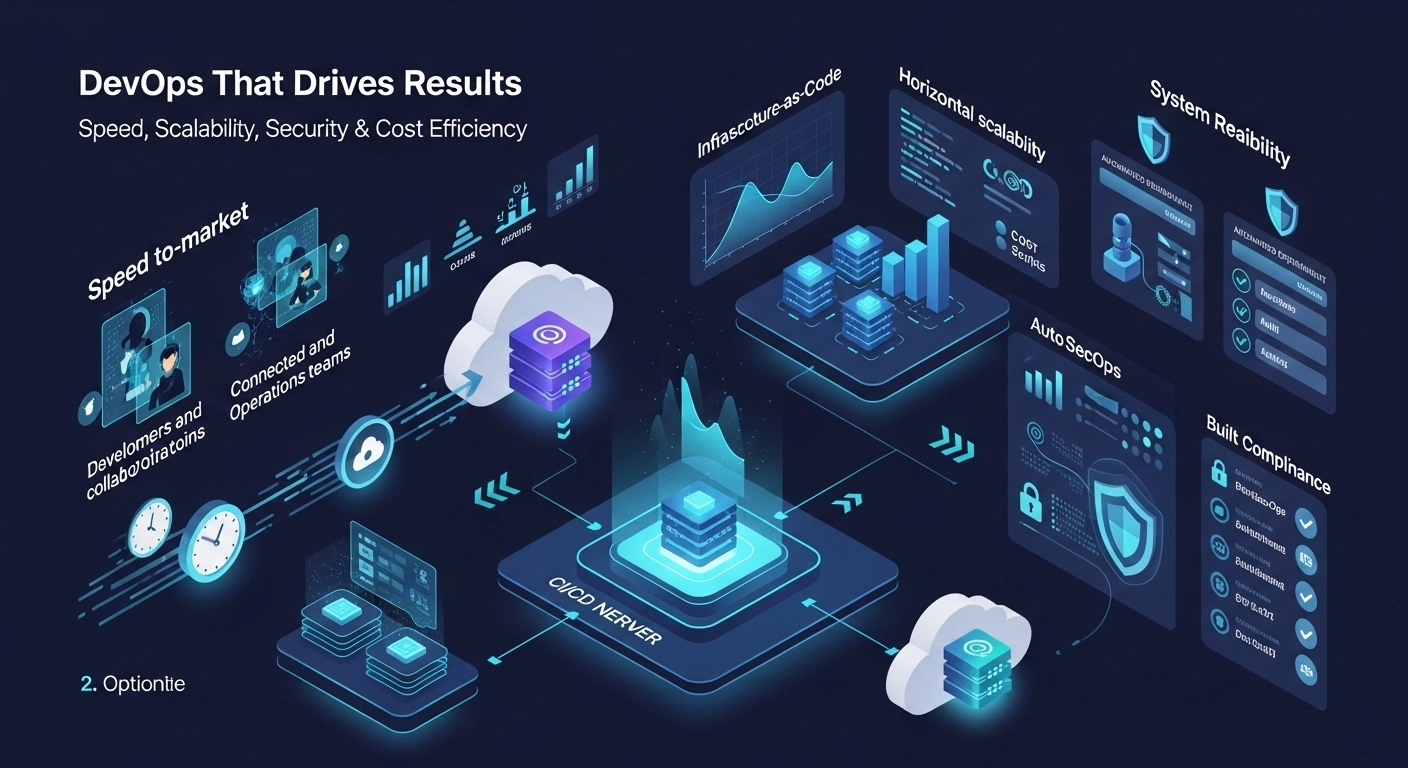
- Faster time to market: Automated pipelines reduce release cycles from weeks to hours.
- Better cross-team collaboration: Shared tooling dissolves the wall between dev and ops.
- Horizontal scalability: Container orchestration and auto-scaling mean your infrastructure grows with demand.
- Significant cost efficiency: IaC eliminates configuration drift and idle capacity spend.
- Higher system reliability: Automated testing and progressive deployments reduce incident frequency.
- Security and compliance built-in: DevSecOps means auditors see systematic controls, not one-off fixes.
Benefits of Professional DevOps Services – Tech Hyves
Top DevOps Tools in 2026
| Tool | Purpose |
|---|---|
| Kubernetes | Container orchestration at scale scheduling, self-healing, scaling |
| Docker | Containerization and reproducible environments |
| GitHub Actions / GitLab CI | Code-adjacent CI/CD with low maintenance overhead |
| Terraform | Declarative Infrastructure as Code across all cloud providers |
| ArgoCD | GitOps-native continuous delivery for Kubernetes |
| Prometheus + Grafana | Open-source monitoring and observability stack |
| Ansible | Agentless configuration management and automation |
| HashiCorp Vault | Secrets management and dynamic credential generation |
| Helm | Kubernetes package manager for repeatable app deployments |
| Trivy | Container and IaC vulnerability scanning |
Latest DevOps Trends in 2026
1. AIOps AI-Augmented Operations
Machine learning models now predict infrastructure failures, auto-triage incidents, and recommend remediation steps before on-call engineers are paged. Tools like Dynatrace Davis and Datadog Watchdog lead this space.
2. Platform Engineering & Internal Developer Platforms
Forward-thinking engineering orgs are building self-service platforms so developers can provision environments and deploy services without needing a ticket. Backstage (CNCF) is the leading framework.
3. GitOps at Scale
Using Git as the single source of truth for both application code and infrastructure state has moved from niche to mainstream. ArgoCD and Flux are the primary tools driving this shift.
4. DevSecOps Automation
Security tooling is being embedded directly in pipelines. Policy-as-code with Open Policy Agent (OPA) enables automated compliance enforcement at the infrastructure level.
5. Multi-Cloud & Hybrid Cloud Strategies
Vendor lock-in anxiety and resilience requirements are pushing enterprises to spread workloads across AWS, Azure, and GCP simultaneously. Kubernetes and Terraform are the glue that makes this manageable.
6. Serverless-First Architecture
Event-driven, serverless workloads are expanding well beyond simple functions entire microservice architectures are going serverless using AWS Lambda, Azure Functions, and Google Cloud Run.
Why Businesses Need DevOps Services The ROI Case
| Metric | Typical Outcome |
|---|---|
| Deployment frequency | 3x to 200x improvement |
| Production incidents | 50% reduction post-adoption |
| Cloud infrastructure cost | 30–45% reduction |
| Manual deployment time | 80% reduction |
| Revenue growth correlation | 3x vs. industry average |
The ROI of professional DevOps services is measurable, fast, and compounding. When your pipeline is automated, your infrastructure is code, and your deployments are zero-downtime, the entire engineering org moves faster and that speed translates directly into revenue.
Beyond speed, DevOps reduces the organizational cost of incidents. Every hour of downtime costs companies an average of $100,000–$300,000 depending on industry. A mature monitoring and incident response practice often pays for itself in prevented outages alone within the first quarter.
Why Choose TechHyves for Your DevOps Services
At TechHyves, we don’t believe in generic DevOps playbooks. Every engagement starts with a deep audit of your current stack, team maturity, and business constraints. From there, we build a tailored roadmap that delivers quick wins within 30 days and long-term infrastructure excellence within 90.
- End-to-end ownership: We design, implement, and hand over with full documentation.
- Stack-agnostic expertise: From legacy monoliths to cloud-native microservices, we’ve done it all.
- Security-first by default: Every pipeline we build has DevSecOps controls baked in from day one.
- Transparent, milestone-based delivery: You always know what’s being built and why.
- Post-launch support: We’re available for ongoing managed DevOps support after delivery.
Ready to transform your delivery pipeline? Book a free 30-minute DevOps audit with TechHyves →
Conclusion
The organizations winning in 2026 are the ones that have made software delivery a competitive advantage, not a bottleneck. With the right DevOps services in place CI/CD, cloud infrastructure management, containerization, IaC, observability, and DevSecOps your team can ship faster, break less, and scale confidently.
TechHyves brings the expertise, tooling experience, and delivery discipline to make that transformation real for your business. The question isn’t whether to invest in DevOps it’s whether you can afford not to.
Get your free DevOps audit today →
Frequently Asked Questions
Q1: What exactly are DevOps Services and what do they include?
DevOps services encompass the full set of practices, tooling, and automation that bridge software development and IT operations. This includes CI/CD pipeline setup, cloud infrastructure management, containerization with Docker and Kubernetes, Infrastructure as Code with Terraform, monitoring and logging, and DevSecOps security integration.
Q2: How long does it take to implement DevOps services for a mid-size company?
For a mid-size company, a foundational DevOps setup including a working CI/CD pipeline, containerized environments, and basic monitoring typically takes 4 to 8 weeks. A full transformation covering IaC, multi-environment cloud architecture, and DevSecOps usually spans 3 to 6 months.
Q3: What is the difference between DevSecOps and DevOps Services?
DevOps focuses on speed and collaboration between development and operations teams. DevSecOps extends this by embedding security controls directly into the CI/CD pipeline rather than treating security as a separate, downstream concern.
Q4: Do I need DevOps services if I’m already using cloud services (AWS/Azure/GCP)?
Yes. The cloud provides infrastructure but not CI/CD, IaC, containerization, or observability automatically. Most companies using AWS, Azure, or GCP still do manual deployments and lack automated testing gates. DevOps services layer the automation and process on top of your cloud provider.
Q5: What ROI can I expect from investing in DevOps services?
ROI is typically realized across three dimensions: speed (3x–10x faster release cycles), reliability (50%+ reduction in production incidents), and cost (30–45% reduction in cloud spend). Most TechHyves clients see measurable ROI within the first 90 days.